GP 221 Källunge kyrka III


mer grejer
0.0
| Plane | Position | Flip |

 |
||

 |
||

 |
| Show planes | Show edges |
Parish Find Location Källunge
Find Location The Romanesque nave of Källunge church.
Find Context Classification Church
Coordinate Find Location (lat) 6390703
Coordinate Find Location (long) 714141
Parish Present Location Källunge
Present Location In situ
Present Location Classification ChurchIn-Loco
Coordinate Present Location (lat) 6390703
Coordinate Present Location (long) 714141
Material Limestone
Height 26
Width 97
Thickness 4
Lindqvist Type A (ca. 400-600)
Lindqvist Shape Kerb stoneUnclear
Runic Inscription or not No
Context and Discovery An apsidal choir built between 1100 and 1150 was the first part of the church, while the present nave and the tower date to around 1150. The small Romanesque choir, however, was replaced by a new and much larger Gothic style choir with sacristy. Both the choir and the sacristy were not finished before 1350. The tiny Romanesque nave could not be used as such anymore and therefore the ʻoversizedʼ choir serves as main part of the church. Six picture stone fragments embedded into the floor of the small nave were published by Sune Lindqvist in 1941/42 (GP 219–224 Källunge kyrka I–VI). In 1984, Beata Böttger-Niedenzu discovered three previously unknown picture stone fragments inside the choir of the church: GP 226–228 Källunge kyrka 8–10. Between 1979 and 1984, another possible picture stone was discovered in front of the sacristy door (GP 225 Källunge kyrka 7). Regarding the stones in the small nave, Lindqvist explains the situation as follows:
“Nos IV and V definitely are parts of one – or possibly two – upright picture stone(s). The others either belong to picture stones, too, or to kerbstones. All these fragments are kept in the Romanesque nave; their upwards-facing obverses are part of the flooring in this area and are flush with the floor. Nos I–V, however, are integrated into the walls, from which they protrude to a width of up to about 30 cm. No. VI gives the impression of being built into the wall in the same way, but closer examination reveals that the exposed part of the stone does not extend into the masonry. As the room has such an edging all around – which perhaps served as a bench earlier, when the floor level was lower – and this in several places is completely covered with lime mortar, it cannot be ruled out that more fragments of picture stones might be observed here in the future. Nos I–III were discovered and sketches drawn of them in 1912, the others were recognised as parts of picture stones only in 1932. Nos I–III are lying in a west-east row at the south side, No. I with its western edge 1 m to the east of the southern portal, No. IV at the west wall just south of the opening to the tower, No. V as second stone in the south wall (counted from the south-west corner), No. VI at the north wall, close to the altar in the north-east corner” (1941/42 II, p. 78).
Since the publication of “Gotlands Bildsteine”, the floor covering of the nave seems to have been renewed. As a result, the stones †GP 222–224 Källung kyrka IV–VI (RAÄ Källunge 54:5–7) are today untraceable and Lindqvist’s descriptions of stones I–III (RAÄ Källunge 54:2–4) suggest that they could be better examined in his time than today. This renewal must have taken place before 1977, as the stones IV–VI could not be found already during the RAÄ inventory. Stones I–III are only documented in the form of drawings (Roosval 1935, fig. 300; Lindqvist 1941/42 II, figs. 425–427), and no illustrations of stones IV–VI are available at all, either in Lindqvist’s book or in the archives in Stockholm and Visby.  GP 219 Källunge kyrka I
 GP 220 Källunge kyrka IIGP 222 Källunge kyrka IVGP 223 Källunge kyrka VGP 224 Källunge kyrka VI
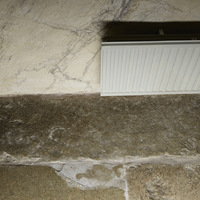 GP 226 Källunge kyrka 8
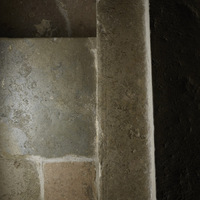 GP 227 Källunge kyrka 9
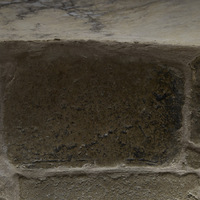 GP 228 Källunge kyrka 10GP 225 Källunge kyrka 7
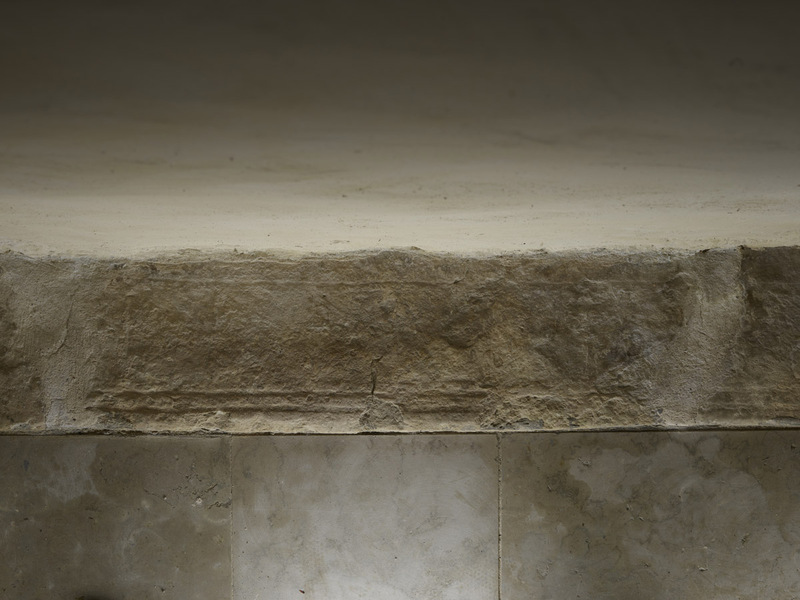
Measurements, Material and Condition The rectangular part of the stone protruding from the wall visible today is 0.26 m x 0.97 m, and 4 cm thick. Lindqvist described it as follows: “Limestone slab, at least 10 cm thick. The obverse probably is worked, the outward-facing narrow side is slightly convex (height of the arc 1 cm to a surviving length of 93 cm) and hewn flat at right angles towards the obverse, with a chamfer of about 1 cm width in between” (1941/42 II, p. 79). The stone’s surface is somewhat abraded but the well-elaborated relief decoration is still discernible.
Description of Ornament and Images “The decoration features two faintly-chiselled, 1 cm wide grooves inside the chamfer, and inside this, a border made up of a row of triangles. These are produced in the same way as the rhombi on No. II, but each triangle also is filled with a carved triangle. The border is limited inwards by a carved line. Beyond this, only a narrow strip of a few centimetres width is visible of the obverse, and on it, no traces of decoration can be determined” (Lindqvist 1941/42 II, p. 79). The ornament consisting of a row of raised triangles is unique and has no striking parallels in the material. However, the make and style are the same as on GP 220 Källunge kyrka II. GP 220 Källunge kyrka II
Interpretation of the Imagery No interpretation
Type and Dating Early-type monument, probably of the kerbstone type (ʻRandsteinʼ in German or ʻkantstenʼ in Swedish) (Lindqvist 1941/42 I, p. 28; II, p. 79). According to Lindqvist, groups of those recumbent kerbstone slabs, belonging to his ʻAbschnittʼ A (circa AD 400–600), formed a kerb which surrounded a grave mound, probably with a large, erected Type A picture stone on top of it. While the unusual geometric border decoration of the stones no. I–III most probably speaks for ʻAbschnittʼ A (see VI), the exact type and function of the monuments remain uncertain due to their fragmentary condition. They could well represent the edge of a kind of upright picture stone.
References Hanna Hegardt in Roosval 1935, p. 207, fig. 300; Lindqvist 1941/42 II, p. 79, fig. 425.
Bildstenen observerades första gången 1912, liggande i långhusets golv.
Nuvarande lokalisering
Samma placering som 1912.
Beskrivning
Troligen en kantsten (period A), 97 cm lång och 26 cm bred, med svaga spår av kantdekor.
Inskrift
Ingen inskrift
Datering
Kan inte dateras med säkerhet, men tillhör perioden cirka 400-600.
Tolkning
Ingen tolkning.
AA
TitleGP 221 Källunge kyrka III
Fornsök ID L1976:4050-4053, 3923, 3924
RAÄ ID Källunge 54 (2-7)
Jan Peder Lamm ID 163
Lindqvist Title Källunge, Kirche III
Last modified Apr 23, 2026