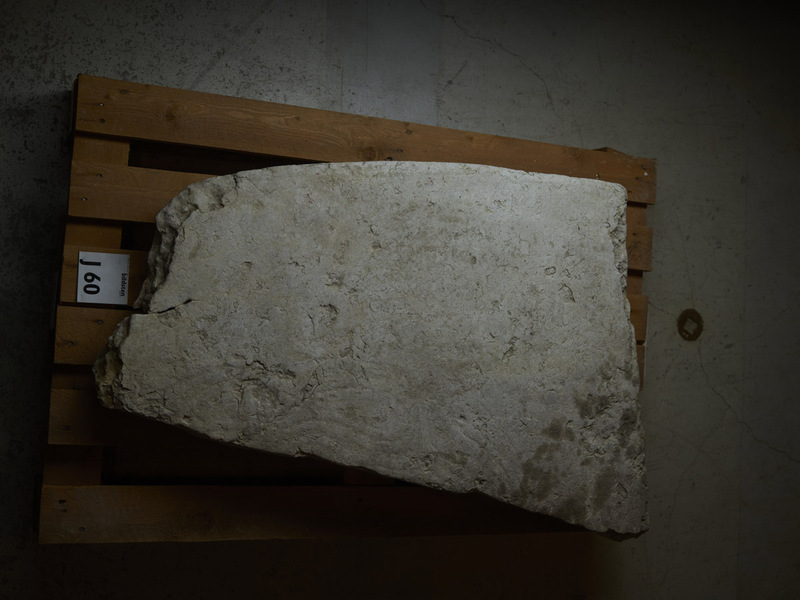
GP 267 Lärbro Nors


mer grejer
0.0
| Plane | Position | Flip |

 |
||

 |
||

 |
| Show planes | Show edges |
Parish Find Location Lärbro
Find Location Property of the farm ʻNors gårdʼ in Lärbro parish.
Find Context Classification Private Property
Present Location Classification SHM Storage
Coordinate Present Location (lat) 6581391
Coordinate Present Location (long) 675775
Context and Discovery “According to information gathered by O. V. Wennersten in 1920, the stone was found ‘several years earlier’ by the farmer Hj. Nilsson in Nors during the digging of a trench between a field of his and his calf pasture bordering Tängelgårda. Just as other stone slabs observed there, the fragment was in a horizontal position. The other stones from the site were used on the farm as stair treads. The surviving fragment was brought to SHM in 1920” (Lindqvist 1941/41 II, p. 91). Possibly, the slabs which have been reused as stair treads represent further fragments of this picture stone. As a matter of fact, the inventory book notes a tall picture stone fragment reused as step on Nors gård (RAÄ no. 547). In Lamm’s list, however, this very fragment (RAÄ no. 547) appears to be listed under the farm name ʻUppegårdaʼ (GP 264 Lärbro Uppegårda/Nors). 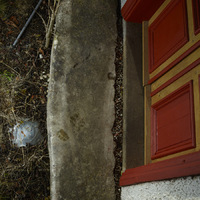 GP 264 Lärbro Uppegårds
Measurements, Material and Condition “Limestone slab, up to 14 cm thick. The obverse is almost flat and severely abraded by footsteps. Of the narrow sides, only part of the original upper side remains. This is convex longitudinally (with a height of 4.5 cm to a length of 87 cm) and hewn flat for 8 cm of its width at an acute angle towards the obverse. There may have existed a narrow chamfer in between, but due to later abrasion and damage to the stone, it is impossible today to say with for certain. The reverse is rough. The longest broken edge is 110 cm long” (Lindqvist 1941/42 II, p. 91).
Description of Ornament and Images Lindqvist (1941/42 II, fig, 446; cf. ATA 457:33 and 1715:68) reproduced a photo of the stone without secondary paint; however, the decoration described by him is hardly discernable in this picture in all details: “Just below the hypothetical chamfer and running parallel to it, there is a shallow, about 1 cm wide groove. In the field, a section of a large roundel can be seen (the diameter was about 90 cm) that is filled with a band pattern in a slightly sunk background field. The roundel appears to have been surrounded by a corona; the corners between the arcs of the semicircles forming it were chiseled.” The corona is hard to observe; neither the photos nor Olof Sörling’s unpublished drawing (ATA, Run- och bildstenssamling) depict it.
Interpretation of the Imagery No interpretation
Type and Dating The slab represents a tall early-type picture stone, i.e. Type A according to Lindqvist’s typology, dating to between AD 400 and 600. Lindqvist (1941/42 I, p. 111–112) compares the band pattern inside the roundel with the unusual horizontal border on the Type A monument GP 537 Vallstena Vallstenarum I, which in his opinion traces back to Celtic ornament, transmitted by Pannonian artists, which is a rather speculative assumption (cf. Arrhenius/Holmqvist 1960, pp. 178–179). Arrhenius and Holmqvist do also consider Coptic parallels (ibid. pp. 189–190, fig. 9). Finally, however, Lindqvist classifies the fragment as representative of his rather randomly composed northern Gotlandic Pavalsgruppe, named after the stone GP 263 Lärbro Pavals that actually does not have much in common with the Nors monument.  GP 537 Vallstena Vallstenarum (I)
 GP 263 Lärbro Pavals
References Lindqvist 1941/42 I, p. 111; II, p. 91, fig. 446; Guber 2011, p. 135 cat. no. 52.
Påträffades flera år före 1920 vid dikesgrävning mellan ägor tillhörande Nors och Tängelgårda. Överfördes till Statens Historiska museum 1920.
Nuvarande lokalisering
Statens Historiska Museum, magasinet i Tumba.
Beskrivning
Fragment av en stor tidig bildsten (period A), bevarad längd 110 cm. Fåror och delar av en stor virvel synliga.
Datering
Dateringen oklar, men den tillhör perioden 400-500-talen.
Tolkning
Ingen tolkning.
AA
TitleGP 267 Lärbro Nors
Jan Peder Lamm ID 182
Statens Historiska Museer ID 16430
Lindqvist Title Lärbro, Nors
Last modified Apr 23, 2026