GP 297 Unknown Find Spot


mer grejer
0.0
| Plane | Position | Flip |

 |
||

 |
||

 |
| Show planes | Show edges |
Parish Find Location Unknown
Find Location Unknown
Find Context Classification Unknown
Present Location Classification Gotlands Museum Magasin Visborg
Coordinate Present Location (lat) 6390259
Coordinate Present Location (long) 695514
Material Limestone
Height 42
Width 58
Thickness 9
Lindqvist Type B (ca. 500-700)
Lindqvist Shape Dwarf stone
Context and Discovery The fragments were found in storage at Gotlands Museum without bearing an inventory number.
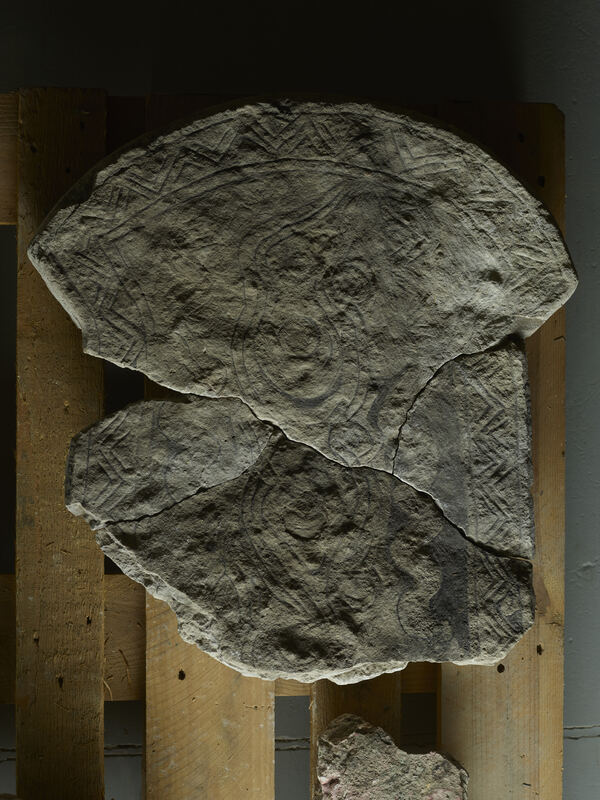
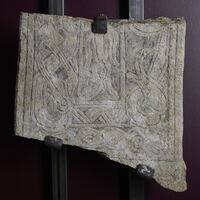
Measurements, Material and Condition The slab represents the almost complete upper part of a small picture stone with its base and root broken off. The surviving limestone slab is broken into four matching pieces, which have the following sizes: 1) 40 x 58 cm, 6 cm thick; 2) 25 x 47 cm, 9 cm thick; 3) 23 x 15 cm, 8cm thick 4) 12 x 21 cm, 4 cm thick. The surface is weathered and, in particular, the decoration in the left half of the image field hard to discern.
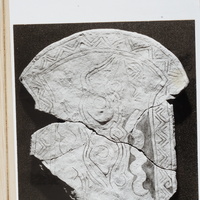
Description of Ornament and Images The stone is framed by an edge border that features a simple zigzag-pattern. The main motif in the image field is hard to describe but appears to represent a kind of vertical interlace, forming two loops which lie on top of each other. This central element is flanked by a pair of wriggling snakes. Presumably, the image represents the same motif as depicted on GP 340 Sanda Sandegårda I – a large, central Style II serpent forming a figure of eight that is flanked by two smaller, more naturalistic wriggling snakes. 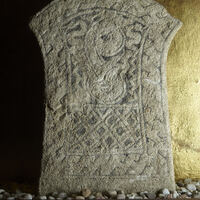 GP 340 Sanda Sandegårda I
Interpretation of the Imagery The image of GP 340 Sanda Sandegårda I is interpreted by Karl Hauck as the supreme god Oðinn in shape of a serpent, accompanied by a pair of snakes (1983a, p. 556). Two more Type B picture stones bear obscure serpent-like ribbon patterns comparable to the image on the stone from Unknown Find Spot – GP 156 Halla Broa XI and GP 335 Rute Ala (see IX). Further depictions of serpents can be seen on GP 368 Stenkyrka kyrka IX, and GP 281 När Smiss 3. See the relevant articles for possible interpretations of serpent motifs. For the interpretation of serpents combined with deer motifs, see GP 551 Väskinde Butter. GP 340 Sanda Sandegårda I GP 156 Halla Broa XI
 GP 335 Rute Ala
 GP 368 Stenkyrka kyrka IX
 GP 281 När Smiss 3
 GP 551 Väskinde Butter
Type and Dating Middle-type picture stone, which means a Type B ʻdwarf stoneʼ, dating between AD 500 and 700. The monument belongs to the group of Type B stones featuring a convex head with pronounced corners protruding horizontally.
Similar serpent-like interlace patterns comparable to the image on the stone from Unknown Find Spot can be observed on GP 335 Rute Ala and GP 156 Halla Broa XI (see VII). Due to their similar shape and strange convoluted ribbon pattern or serpent motif, Lindqvist (1941/42 I, p. 37–38) assigns them to his Alagruppe, named after Rute Ala. According to Larsen (2009, pp. 32, 35–36), who investigated the stones by 3D scanning, the serpent-like ornaments on both stones are typical for the 7th century animal style. In his opinion, they originate from one and the same stone carver. In Lindqvistʼs time, these two monuments were the only known picture stones decorated in this way. A third specimen, however, is represented by the recent find from Unknown Find Spot. Furthermore, there is good reason to assume that GP 340 Sanda Sandegårda I belongs to this group as well, indicating that the interlace pattern on those stones actually represents a serpent.
The zigzag pattern (see VI) is not very common among the Type B monuments. Most comparable are the horizontal borders of GP 129 Hablingbo Stenstu and GP 368 Stenkyrka kyrka IX. GP 335 Rute AlaGP 156 Halla Broa XIGP 340 Sanda Sandegårda I GP 129 Hablingbo StenstuGP 368 Stenkyrka kyrka IX
References Guber 2011, pp. 70, 160 cat. no. 102; Oehrl/Fergusson in print, fig. 25.
Okänd
Nuvarande lokalisering
Gotlands museum, magasinet på Visborgsslätt.
Beskrivning
Övre delen av en dvärgsten, bruten i fyra delar (period B), med kantdekor och i bildfältet två lopar omgivna på ömse sidor av en orm.
Datering
Dateringen oklar, men tillhör perioden 500-600-talen.
Tolkning
Ingen tolkning.
AA
TitleGP 297 Unknown Find Spot
Gotlands Museum ID GFC11052
Jan Peder Lamm ID 374
Last modified Apr 23, 2026