GP 329 Roma klosterruin


mer grejer
0.0
| Plane | Position | Flip |

 |
||

 |
||

 |
| Show planes | Show edges |
Parish Find Location Roma
Find Location Next to the ruined monastery of Roma in Roma/Björke parish.
Find Context Classification Other
Present Location Classification SHM Storage
Coordinate Present Location (lat) 6581391
Coordinate Present Location (long) 675775
Material Limestone
Height 42
Width 21
Thickness 6
Lindqvist Type B (ca. 500-700)
Lindqvist Shape Dwarf stone
Iconographic Keywords boat
Runic Inscription or not No
Context and Discovery The three fragments of a small picture stones were found while digging a trench just outside the ruins. They were brought to Statens Historiska Museum in 1912 by E. Eckhoff (cf. Lindqvist 1941/42 II, p. 106).
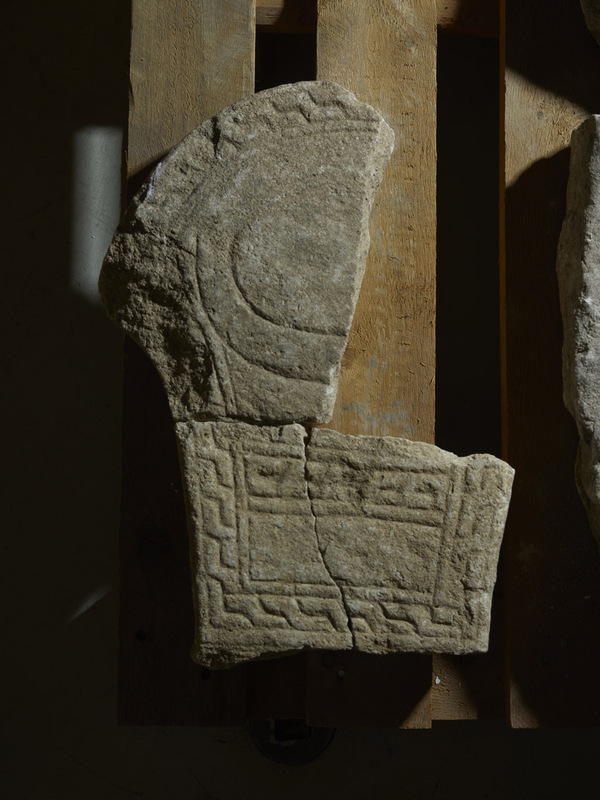
Measurements, Material and Condition “Limestone slab, up to 6 cm thick. Both broad sides are quite even and presumably hewn, at least partly. The narrow sides are hewn at right angles towards the broad sides, and there are chamfers of almost 1 cm width towards both sides. The stone’s height above the (mainly lost) root is 42 cm. The width at the base is 21 cm” (Lindqvist 1941/42 II, p. 106). The stone, whose root is missing, consists of three matching pieces – the left (when looking at the better-preserved face A) half of the head, and two halves of the stone’s body. The surface of face B is weathered and partly damaged.
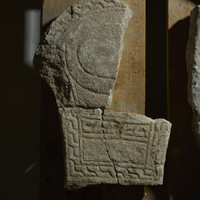
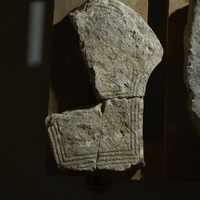
Description of Ornament and Images The relief-like carvings are very easily discernable, wherefore Lindqvist did not paint them (1941/42 II, figs. 473–474; cf. ATA 1718:69–70 [H. Faith-Ell 1933]). A drawing by Olof Sörling is kept in ATA as well (2440:30). “The decoration is executed in up to 3 mm wide and 2 mm deep lines with rather sharp bases. [Face A] features a framing border with a simplified ‘twisted cord’ pattern. Half-way up the body, the field is divided into two parts by a horizontal border, also with a simplified ‘twisted cord’ pattern. The lower field appears to be undecorated, while the upper one is adorned with the image of a watercraft, which, judging from its surviving half, did not have a mast and sail, but sharply towering stems that high above the keel sharply bend inwards. [Face B] has a framing border of three or four parallel lines. Half-way up the stone, the field is divided into two halves by two or possibly three parallel lines, but there are no traces of imagery” (Lindqvist 1941/42 II, p. 106).
Interpretation of the Imagery No interpretation
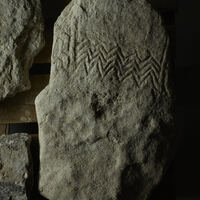
Type and Dating Middle-type picture stone, i.e., Type B according to Lindqvist, dating between AD 500 and 700. The stone belongs to those Type B stones described by Lindqvist (1941/42 I, pp. 38–39) as ʻdwarf stonesʼ with convex head and corners protruding horizontally. Lindqvist assigns Roma klosterruin to his so-called Stenstugruppe (1941/42 I, pp. 37–38), which is characterized by the shape as well as depictions of aquatic birds in the lower and a simple vessel (i.e., ships of the Rikvidetyp – ibid. I, p. 66) in the upper field of the stone. However, Lindqvist does not exclusively assign stones with bird depictions to this group. These monuments are frequently decorated on both sides. Lindqvist considers them to have been placed pairwise on graves. The best parallel to Roma klosterruin, regarding shape and decoration, is GP 142 Halla Broa VII. The twisted cord pattern on the Roma stone is raised, executed as a kind of bas-relief, similar to GP 93 Gammelgarn Högstens.
According to Martin Rundkvist’s (2012, p. 159) typology, the stone’s shape represents Type dwarf3, belonging to his period 3, which he dates to the Middle Vendel Period. Varenius (1992, p. 58, appendix 2) assigns the ship depiction on Roma klosterruin to his group 1 (rigglösa skepp), which he dates to the period between the 5th and the 6th century.  GP 142 Halla Broa VII
 GP 93 Gammelgarn Högstens
References Lindqvist 1941/42 I, p. 66; II, p. 106, figs. 473–474; Varenius 1992, p. 58 Guber 2011, p. 140 cat. no. 61.
Tre fragment av en bildsten påträffades vid grävning av ett schakt utanför klosterruinen i Roma. Fragmenten fördes till Statens Historiska Museum 1912.
Nuvarande lokalisering
Statens Historiska Museum, magasinet i Tumba
Beskrivning
Tre fragment av en mindre bildsten (period B), bevarad höjd 42 cm och största bredd 21 cm. Bildstenen omfattar två bildfält, det övre ett skepp utan mast eller segel, det nedre utan bild.
Datering
Kan inte dateras med säkerhet, men tillhör perioden 500-600-talen.
Tolkning
Ingen tolkning.
AA
TitleGP 329 Roma klosterruin
Jan Peder Lamm ID 206
Statens Historiska Museer ID 14636
Lindqvist Title Roma, Kloster
Last modified Apr 17, 2025