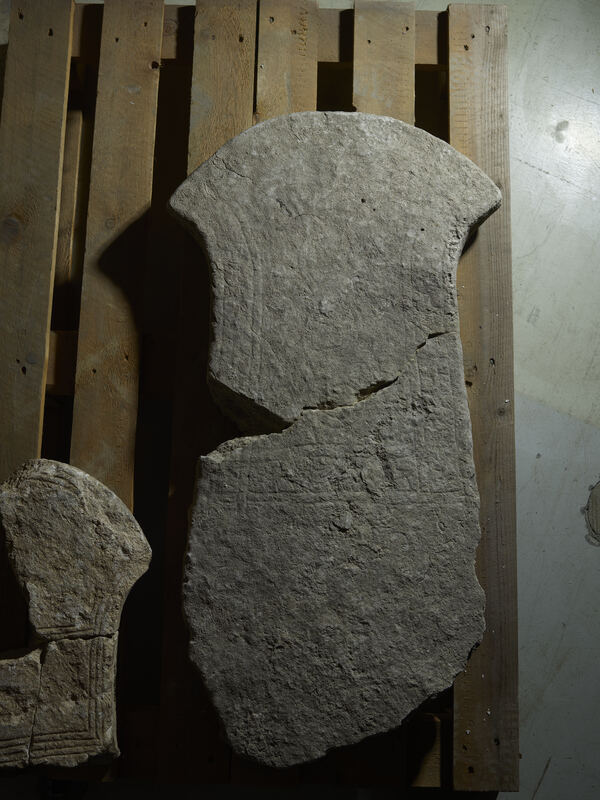
GP 335 Rute Ala


mer grejer
0.0
| Plane | Position | Flip |

 |
||

 |
||

 |
| Show planes | Show edges |
Parish Find Location Rute
Find Location A meadow (‘Fardume äng’) belonging to the village Ala in Rute parish.
Find Context Classification Agricultural Field
Present Location Classification SHM Storage
Coordinate Present Location (lat) 6581391
Coordinate Present Location (long) 675775
Material Limestone
Height 93
Width 50
Thickness 8
Lindqvist Type B (ca. 500-700)
Lindqvist Shape Dwarf stone
Context and Discovery There is not much information available about the find circumstances, Lindqvist (1941/42 II, p. 107) summarises: “This picture stone was found in 1900 by the farmer J. Österdahl while cultivating one of his meadows that due to its location close by the farm Fardume was called ‘Fardume äng’ (Fardume meadow). In this meadow there were several stone mounds and the remains of an old pathway. The picture stone lay one foot below ground and was undamaged on discovery.”
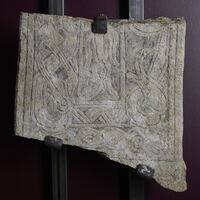
Measurements, Material and Condition “Limestone slab, 8 cm thick. The obverse is even, the narrow sides hewn at right angles towards the obverse and in places feature a clearly discernible, just under 1 cm wide chamfer in between. The reverse is rough and unworked. The total height is 93 cm, of which 60 cm are accounted for by the part above the base. The width between the upper corners is 50 cm” (Lindqvist 1941/42 II, p. 107). The small monument is almost completely preserved but broken into an upper and a lower half. Approximately at half-height of the slab, a small part of the left edge is broken off and missing. The decorated surface is worn or weathered.
Description of Ornament and Images Lindqvist’s description is very brief and insufficient (1941/42 II, p. 107): “Decorated with about 2–3 mm wide lines that at least today are rather shallow. The approximately 8 cm wide framing border is filled with a rich band pattern, as is the central part of the field.” As a matter of fact, in the only picture of the stone provided by Lindqvist, a photo of the unpainted carvings (ibid. I, fig. 39, cf. ATA 1718:62 [H. Faith-Ell 1933]), nothing more than the frame of the border can be identified with certainty while its decoration as well as the motif in the image field remain very unclear. Elsewhere (ibid. I, p. 37), the latter is enigmatically described as “stark verwirrte Schlingflechtung” (ʻstrongly convoluted loop interlacingʼ).
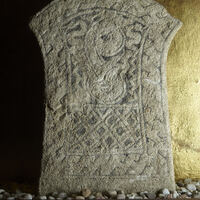
However, an unpublished drawing by Olof Sörling kept in ATA considers more details (Run- och bildstenssamling 2440:18) – the remains of the border decoration look geometric (cf. Rundkvist 2012, p. 160), reminiscent of the typical simplified twisted cord pattern which occurs regularly on Type B monuments, or a more realistic variant similar to the interlace borders on stones like GP 83 Fole kyrka, GP 340 Sanda Sandegårda I, and GP 74 Endre skog. The main motif in the image field could be described, according to Sörling’s drawing, as a vertical interlace consisting of two slim ribbons, forming a row of loops, almost chain-like, and which indeed is reminiscent of a serpent (or a pair of serpents respectively). 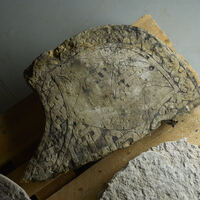 GP 83 Fole kyrka
 GP 340 Sanda Sandegårda I
 GP 74 Endre skog
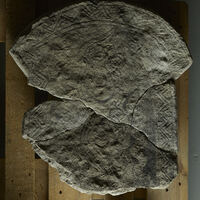
Interpretation of the Imagery Two more Type B picture stones bear obscure serpent-like ribbon patterns comparable to Rute Ala – GP 156 Halla Broa XI and GP 297 Unknown find spot (see IX). Unambiguous depictions of serpents can be seen on GP 340 Sanda Sandegårda I, GP 368 Stenkyrka kyrka IX, and GP 281 När Smiss 3. See the relevant articles for possible interpretations of serpent motifs. For the interpretation of serpents combined with deer motifs, see GP 551 Väskinde Butter.  GP 156 Halla Broa XI
 GP 297 Unknown Find SpotGP 340 Sanda Sandegårda I
 GP 368 Stenkyrka kyrka IX
 GP 281 När Smiss 3
 GP 551 Väskinde Butter
Type and Dating Middle-type picture stone, which means a Type B ʻdwarf stoneʼ, dating between AD 500 and 700. The monument belongs to the group of Type B stones featuring a convex head with pronounced corners protruding horizontally. According to Martin Rundkvist’s (2012, p. 159) typology, the stone’s shape represents Type dwarf2, belonging to his period 2, which he dates to the Early Vendel Period. According to Larsen (2009, pp. 32, 35–36), who investigated the stone by 3D scanning, the serpent-like ornaments on Rute Ala and GP 156 Halla Broa XI are typical for the 7th century animal style. Due to their similar shape and strange convoluted ribbon pattern or serpent motif, Lindqvist (1941/42 I, p. 37–38) assigns both stones to his Alagruppe, named after Rute Ala. In Larsen’s opinion (2009, p. 36), they originate from one and the same stone carver. At Lindqvistʼs time, these two monuments were the only known picture stones decorated in this way. A third specimen, however, is represented by the recent find GP 297 Unknown Find Spot. GP 156 Halla Broa XIGP 297 Unknown Find Spot
References Lindqvist 1941/42 I, fig. 39; II, p. 107; Larsen 2009, p. 35–6, fig 34; Guber 2011, p. 140 cat. no. 62; Oehrl 2019a, p. 11, pl. 2e.
Bildstenen påträffades 1900 vid uppodling av Fardume äng tillhörande gården Ala. I ängen fanns flera stenrösen och rester av en gammal väg.
Nuvarande lokalisering
Statens Historiska Museum, magasinet i Tumba
Beskrivning
Helt bevarad mindre bildsten (period B), 93 cm hög och som bredast 60 cm. Kantdekor bevarad liksom ett bildfält med en kedjelik rad av öglor, kanske en orm eller två ormar.
Datering
Kan inte dateras med säkerhet, men tillhör perioden 500-600-talen.
Tolkning
Ingen tolkning.
AA
TitleGP 335 Rute Ala
Jan Peder Lamm ID 210
Statens Historiska Museer ID 14749
Lindqvist Title Rute, Ala
Last modified Apr 23, 2026