GP 336 Rute Fardume


mer grejer
0.0
| Plane | Position | Flip |

 |
||

 |
||

 |
| Show planes | Show edges |
Parish Find Location Rute
Find Location The front yard of ʻFardume gårdʼ in Rute parish.
Find Context Classification Farmstead
Present Location Classification Gotlands Museum Magasin Visborg
Coordinate Present Location (lat) 6390259
Coordinate Present Location (long) 695514
Material Limestone
Limestone Type coarse reef debris limestone
Geological Group Slite Group (100%)
Height 75
Width 58
Thickness 11
Lindqvist Type B (ca. 500-700)
Lindqvist Shape Dwarf stone
Runic Inscription or not No
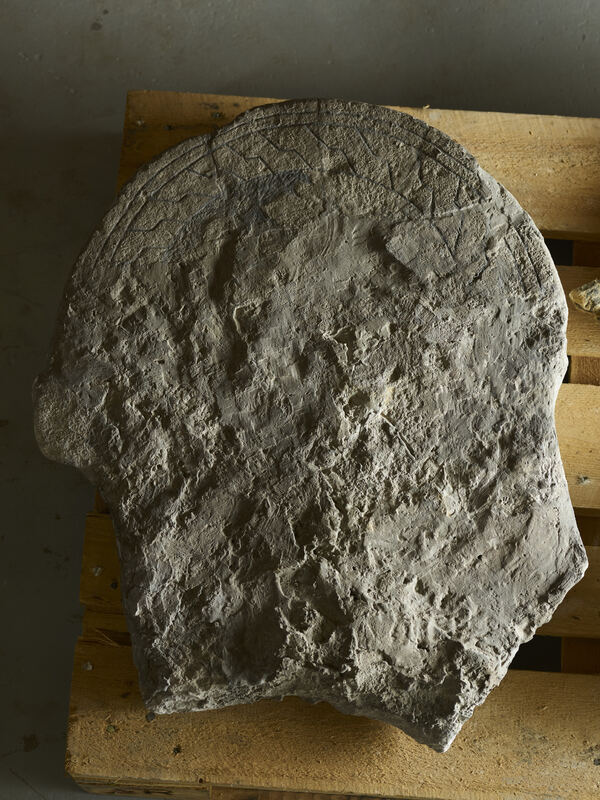
Context and Discovery The fragment represents the upper part, i.e., the head and parts of the neck, of a small picture stone “[…] that was found in the spring of 1927 by Ture Carlsson in the front yard of Fardume farm. Later, the stone was brought to the neighbouring medieval ruin, where it was broken up into several small pieces that in 1933 were taken to the museum GF and, as far as possible, reassembled” (Lindqvist 1941/42 II, p. 107). The place where the stone had been kept and destroyed seems to be ʻFardume slottʼ, a medieval farmstead with the ruin of a fortified tower (kastal) called ʻMynttornetʼ and a stone house (RAÄ Rute 4:1–2). The complex dates to AD 1200 at the latest. Whether there is an original relationship between the stone and the medieval farm, however, remains speculative. The first photo of the stone by Ture Carlsson in 1927 was, according to its caption, taken 100 m south of the medieval building (ATA Run- och bildstenssamling, dnr 1853/27).
Measurements, Material and Condition Lindqvist (1941/42 II, p. 107), in whose time the stone had already been destroyed and tentatively reassembled (ibid. fig. 475), describes it as follows: “Limestone slab, 9 cm thick. The obverse is even […], the narrow sides are hewn at right angles towards the obverse, with hardly a chamfer in between. The reverse is rough and unworked, but rather even. The width between the upper corners is about 55 cm”. According to Ture Carlsson’s photo, the original fragment preserved almost the entire semi-circular head of a small picture stone, including its left corner and insignificant parts of its neck.
Description of Ornament and Images “Decorated with 2 mm wide lines with rounded bases that form a framing border with its double outside line and simplified ‘twisted cord’ pattern as well as a now indistinct figure in the panel” (Lindqvist 1941/42 II, p. 107). Lindqvist’s photo of the painted stone (ibid. fig. 475) depicts only a small part of the border and only a bit of the sunken background and a tiny piece of a raised area in the image field. Ture Carlsson’s photo from 1927, however, on which the carvings had been traced with white chalk, the border can be seen running along the entire convex edge of the stone, as well as two facing S-shaped elements in the head field.
Interpretation of the Imagery No interpretation
Type and Dating The size and the remaining border decoration of the fragment indicate a middle-type picture stone, i.e., Type B according to Lindqvist, dating to between AD 500 and 700. The head of the ʻdwarf stoneʼ is almost semi-circular, and its left corner is partly preserved. The corners had protruded rather downwards than horizontally, as can be seen from Ture Carlsson’s photo from 1927.
References Lindqvist 1941/42 II, p. 107, fig. 475.
Bildstenen påträffades 1927 på gårdsplanen till Fardume gård. Senare fördes bildstenen till den medeltida ruinen Fardume slott, där den bröts sönder i flera delar. Delarna samlades in och överfördes till Gotlands museum.
Nuvarande lokalisering
Gotlands museum, magasinet på Visborgsslätt
Beskrivning
Flera fragment av mindre bildsten (period B), med största bredd på 55 cm. Kantdekor bevarad.
Datering
Kan inte dateras med säkerhet, men tillhör perioden 500-600-talen.
Tolkning
Ingen tolkning.
AA
TitleGP 336 Rute Fardume
Gotlands Museum ID GFC9200
Jan Peder Lamm ID 211
Lindqvist Title Rute, Fardume
Last modified Apr 23, 2026